Credibility: How Leaders Gain and Lose It, Why People Demand It, Revised Edition by James M. Kouzes & Barry Z. Posner
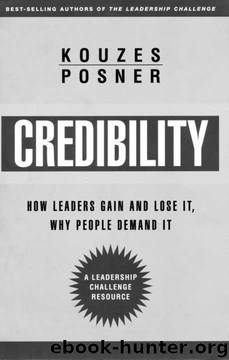
Author:James M. Kouzes & Barry Z. Posner [Kouzes, James M. & Posner, Barry Z.]
Language: eng
Format: epub
ISBN: 9780787964641
Amazon: 0787964646
Publisher: Jossey-Bass
Published: 2003-01-21T00:00:00+00:00
LIBERATING THE LEADER IN EVERYONE
The cover of a recent Fortune magazine shows a group of seven employees huddled around a gigantic carton of cereal. This is a work group at the General Mills cereal plant in Lodi, California, whose productivity increased nearly 40 percent since these employees became responsible for managing themselves without a "boss." The headline asks "Who Needs a Boss?"3 Who, indeed.
Myth has it that leadership is a function of position. Nonsense. Leadership is a set of skills and practices that can be learned regardless of whether or not one is in a formal management position. Leadership is found in those in the boiler room and those in the board room. It is not conferred by title or degree. In fact, often those responsible for the smooth and successful operation of organizations, from the youth soccer league to the church fellowship, have neither.
We have learned from our research that within effective teams the behaviors of individual contributors are practically identical to those of leaders. Scores from individual contributors on the Team Leadership Practices Inventory reveal that there is more leadership exhibited among the individual members within high-performing work groups than within equivalent low-performing work groups. United in a common cause, every member of the team becomes responsible for providing leadership. Self-led teams outperform teams that are tightly managed, either by a controlling supervisor or the team members themselves. Self-led groups are more effective than selfmanaged groups.4
Developing capacity requires us to ask ourselves about the assumptions we make regarding the abilities of the people we lead. Just how far are we willing to go to develop the skills people need to contribute to making our shared values a way of life?
Credible leaders turn their constituents into leaders. This is the essence of how leaders get extraordinary things done in their organizations: they enable people to act. It is not a case of the leader doing something or even telling others what to do but of everyone wanting to work together for a common purpose, one that is aligned with shared values. "My personal best as a leadet," explains Alan Daddow, regional manager with Elders Pastoral in Australia, "simply involved being able to maximize my staffs potential." Organizational effectiveness depends upon the sharing or distributing, not the hoarding, of leadership.
Empowerment is an important concept but one often misunderstood; perhaps it's even an obsolete term. The problem with empowerment is that it suggests that this is something leaders magically give or do for others. But people already have tremendous power. It is not a matter of giving it to them, but of freeing them to use the power and skills they already have. It is a matter of expanding their opportunities to use themselves in service of a common and meaningful purpose. What is often called empowerment is really just taking off the chains and letting people loose. Credible leaders in this sense are liberators.
You can sense the liberation by recalling our earlier discussion (in Chapter Two) about how working with
Download
This site does not store any files on its server. We only index and link to content provided by other sites. Please contact the content providers to delete copyright contents if any and email us, we'll remove relevant links or contents immediately.
Pioneering Portfolio Management by David F. Swensen(6305)
Man-made Catastrophes and Risk Information Concealment by Dmitry Chernov & Didier Sornette(6026)
Zero to One by Peter Thiel(5808)
The Motivation Myth by Jeff Haden(5216)
The Miracle Morning by Hal Elrod(4734)
Elon Musk by Ashlee Vance(4130)
Unlabel: Selling You Without Selling Out by Marc Ecko(3668)
The Art of Persistence: Stop Quitting, Ignore Shiny Objects and Climb Your Way to Success by Michal Stawicki(3662)
Delivering Happiness by Tony Hsieh(3433)
Urban Outlaw by Magnus Walker(3403)
Purple Cow by Seth Godin(3208)
The Marketing Plan Handbook: Develop Big-Picture Marketing Plans for Pennies on the Dollar by Robert W. Bly(3070)
Mastering Bitcoin: Programming the Open Blockchain by Andreas M. Antonopoulos(3050)
The Power of Broke by Daymond John(2992)
The Content Trap by Bharat Anand(2928)
Applied Empathy by Michael Ventura(2911)
The Airbnb Story by Leigh Gallagher(2862)
Keep Going by Austin Kleon(2768)
Radical Candor by Kim Scott(2726)
